
How Long Should You Expect to Wait on an IRS Notice or Audit?
If you've mailed a response to the IRS and haven't heard anything back, the silence can feel alarming. It's natural to want to call and check. But with the IRS, timing that call matters as much as making it. Calling or writing too soon can genuinely slow your case down.
Here is a realistic, IRS-informed guide to how long common tax matters actually take, and when following up actually helps rather than hurts. Given ongoing IRS staffing constraints, actual wait times can run longer than the ranges below, so treat these as planning benchmarks rather than guarantees.
Why Following Up Too Early Can Backfire
The IRS processes cases largely on a first-in, first-out basis. When you call before your case has reached the front of the queue, an agent typically cannot access it or do anything to move it faster. The call simply uses up time without changing your outcome.
Written follow-ups carry a bigger risk. Submitting a second letter or response “just to check” can cause the IRS system to flag it as a duplicate. In some cases, that flag removes the original submission from the queue and restarts the processing clock, adding weeks or months to a case that may already have been close to resolution.
The practical takeaway: patience is not passive. It is often the fastest path to resolution.
Types of IRS Notices and Correspondence
Most IRS notices come with a response deadline, commonly 30 days, to preserve your appeal rights or avoid automatic penalties. Once you have responded, though, processing takes considerably longer than most people expect.
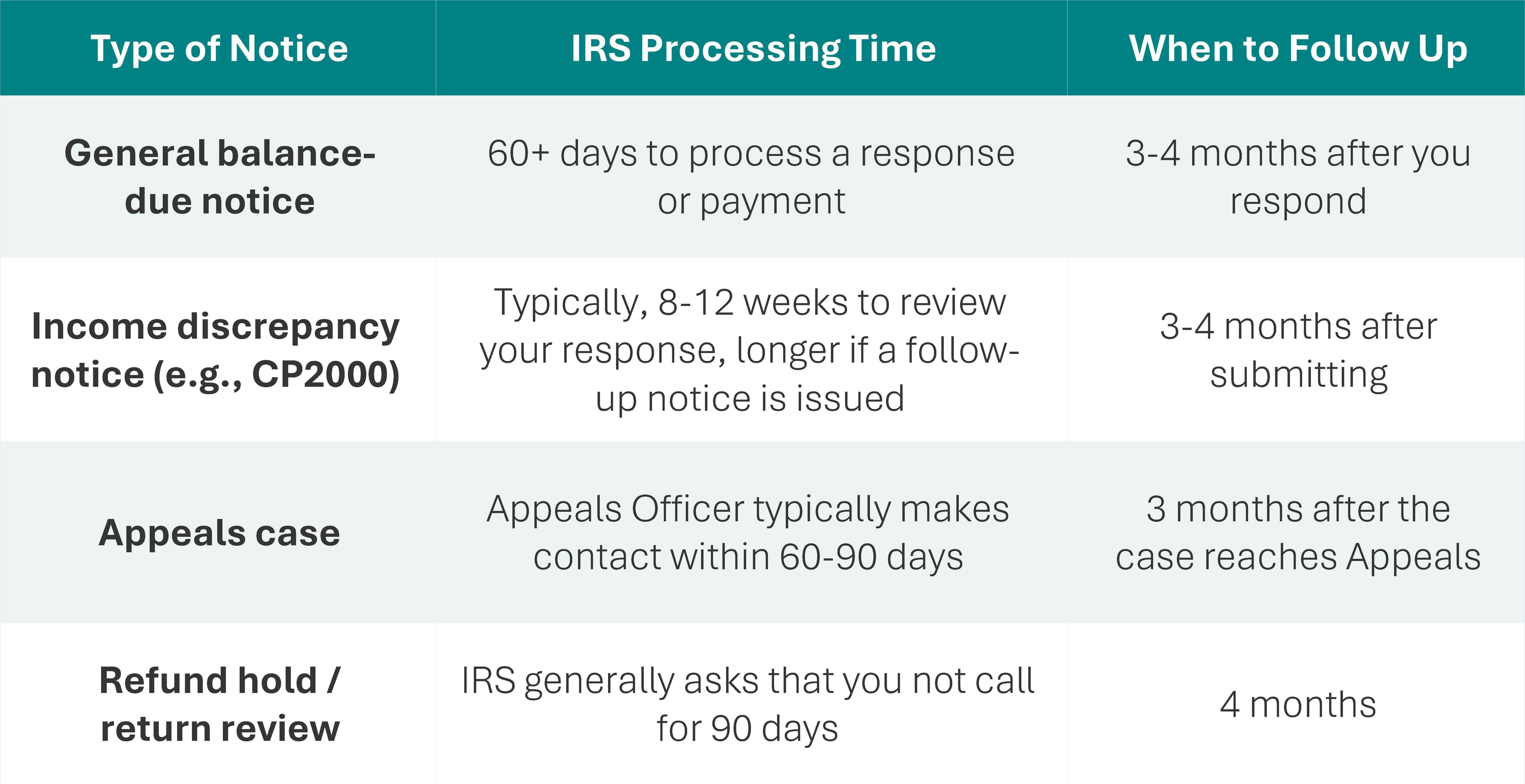
If a CP2000 response escalates to a formal Notice of Deficiency, that notice carries a strict, non-extendable 90-day deadline to petition Tax Court, so it is worth having someone track that deadline closely rather than relying on memory.
Types of IRS Audits
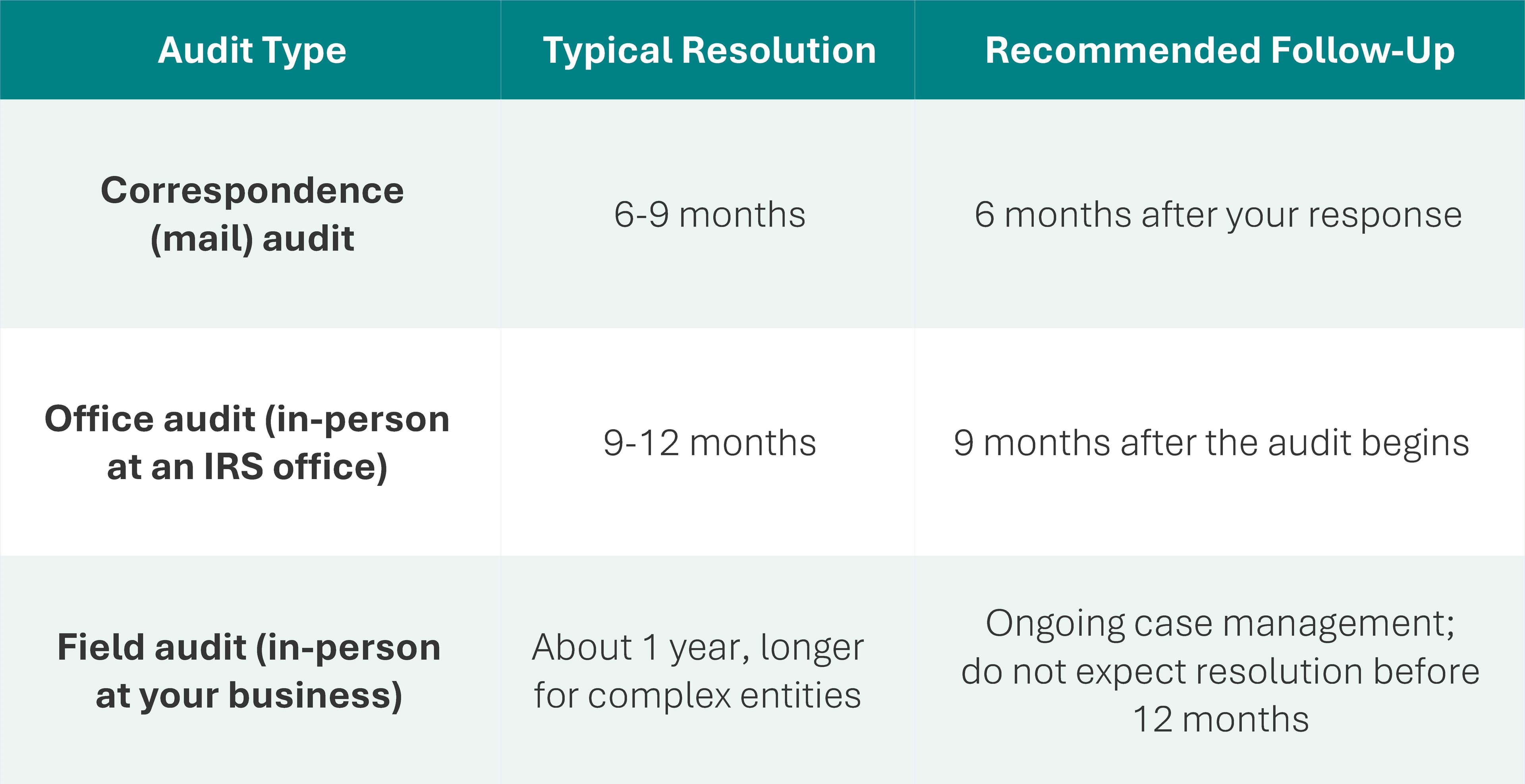
Audit length depends heavily on scope and complexity, but the ranges below hold up as reasonable planning benchmarks.
Amended Returns (Form 1040-X)
Amended returns move slowly because each one requires manual review, an examiner comparing your original filing, your changes, and your corrected figures line by line.
Status typically becomes visible in the IRS “Where's My Amended Return?” tool about 3 weeks after filing.
The IRS's standard guidance is 8 to 16 weeks for processing, but current backlogs have pushed many cases toward 4 to 5 months or longer, so calling before 4 months rarely accomplishes anything.
If nothing has changed after 6 to 9 months, that is the appropriate point for a formal follow-up.
Identity Theft and Identity Verification
These two situations are often confused, but they resolve very differently. A one-time identity verification request (confirming a return was really filed by you) typically resolves within about 60 days of completing the verification, and a follow-up around 2 months out is reasonable if nothing has updated.
A tax-related identity theft case, where a fraudulent return was filed in your name and an affidavit (Form 14039) is required, is a much longer process. The National Taxpayer Advocate's most recent reports to Congress put the average resolution time at roughly 20 to 22 months, and the Advocate has publicly called these delays unacceptable. Given that timeline, we recommend a check-in every 6 months rather than repeated inquiries. Filing duplicate affidavits does not speed the case up. It resets the clock, the same way a duplicate letter does with a notice.
Tips for Calling the IRS
Reaching a live representative is one of the most consistent bottlenecks in the entire process. A few practical notes:
Call right at 7:00 a.m. local time, or in the late afternoon after 4:00 p.m., when hold times tend to be shortest.
Avoid Mondays and the days right after a holiday, historically the busiest call times; Wednesday tends to be the lightest day, with Thursday a close second.
Avoid the late-morning to early-afternoon window (11 a.m. to 2 p.m.), which tends to be the busiest stretch of the day.
Repeated calls before your window has passed do not move your case forward. They simply take time away from staff working through the queue.
Help with IRS Notices
None of this means you should ignore an IRS notice or stop tracking your case. Deadlines for your response still matter, and missing one can trigger real consequences like penalties or enforcement action. What it does mean is that once you have responded, the most effective thing you can usually do is wait through the IRS's stated processing window before following up again.
This is exactly the kind of case management our tax controversy team handles every day. We track deadlines, monitor case status, and know precisely when a follow-up will actually help rather than reset the clock. If you are navigating a notice, an audit, or an identity theft case and are not sure where you stand, contact Clark Schaefer Hackett's tax controversy practice for guidance built on direct experience resolving these cases with the IRS.