
Is a Cost Segregation Study Worth It on a Rehab Deal?
If you're renovating a property this year, whether that's a preservation rehab of an aging Low-Income Housing Tax Credit (LIHTC) property or a commercial or multifamily renovation, the math on cost segregation just changed in your favor. For years, many owners doing rehab work skipped a cost segregation study because bonus depreciation was on its way out. That calculation no longer holds.
The underlying mechanics of cost segregation haven't changed. What changed is the payoff. A study that would have accelerated a modest, shrinking deduction two years ago now accelerates a full first-year write-off. That difference is large enough to be worth revisiting even for owners who looked at this before and passed.
How OBBBA Restored 100% Bonus Depreciation for Rehab Projects
Bonus depreciation was on a scheduled decline under prior law, stepping down year after year and set to disappear entirely after 2026. That trajectory made cost segregation a shrinking benefit, and plenty of owners reasonably decided the study wasn't worth commissioning. The One Big Beautiful Bill Act (OBBBA) reversed that entirely, restoring 100% bonus depreciation for qualifying property placed in service after January 19, 2025. That date carries a second condition worth flagging for any rehab already underway. Qualifying requires both:
A placed-in-service date after January 19, 2025.
An acquisition date after January 19, 2025.
Property under a binding written contract signed before January 20, 2025 stays on the prior, lower bonus rate even if the project itself is completed well into 2026, so a rehab's contract date matters as much as its completion date. A benefit that was fading out is now back at full strength. For anyone with a 2026 rehab underway, that reversal is worth revisiting even if you ruled out cost segregation a year or two ago.
What Actually Qualifies in a Rehab
Structural components generally don't qualify for reclassification. The building's core shell stays on its standard depreciation schedule. But a meaningful share of a typical rehab budget often does qualify:
Mechanical systems
Electrical work
Plumbing fixtures
Specialty lighting
Flooring
Certain land improvements
These can frequently be reclassified into 5-year or 15-year property instead of the standard longer schedule. Exactly what qualifies depends on the specific scope of work, which is why a proper engineering-based study, not a rule-of-thumb estimate, is what actually identifies it.
This is also where the repair and capitalization regulations add a layer worth being careful with. Some rehab costs that feel like they should qualify for reclassification are instead required to be capitalized differently under those rules. Treating the two frameworks as interchangeable is a common way owners overstate what a study will actually find. An engineering-based study accounts for this distinction directly rather than assuming every renovation dollar is eligible.
Cost Segregation Example: First-Year Deductions on a $3 Million Rehab
Here's a representative example. Assume a $3 million rehab where a cost segregation study identifies $600,000 of components eligible for reclassification into 5- and 15-year property. To keep the comparison simple, the straight-line figures below assume a full first year of depreciation. In practice, the actual first-year amount also depends on the month the property is placed in service, so your real numbers will vary somewhat from this example.
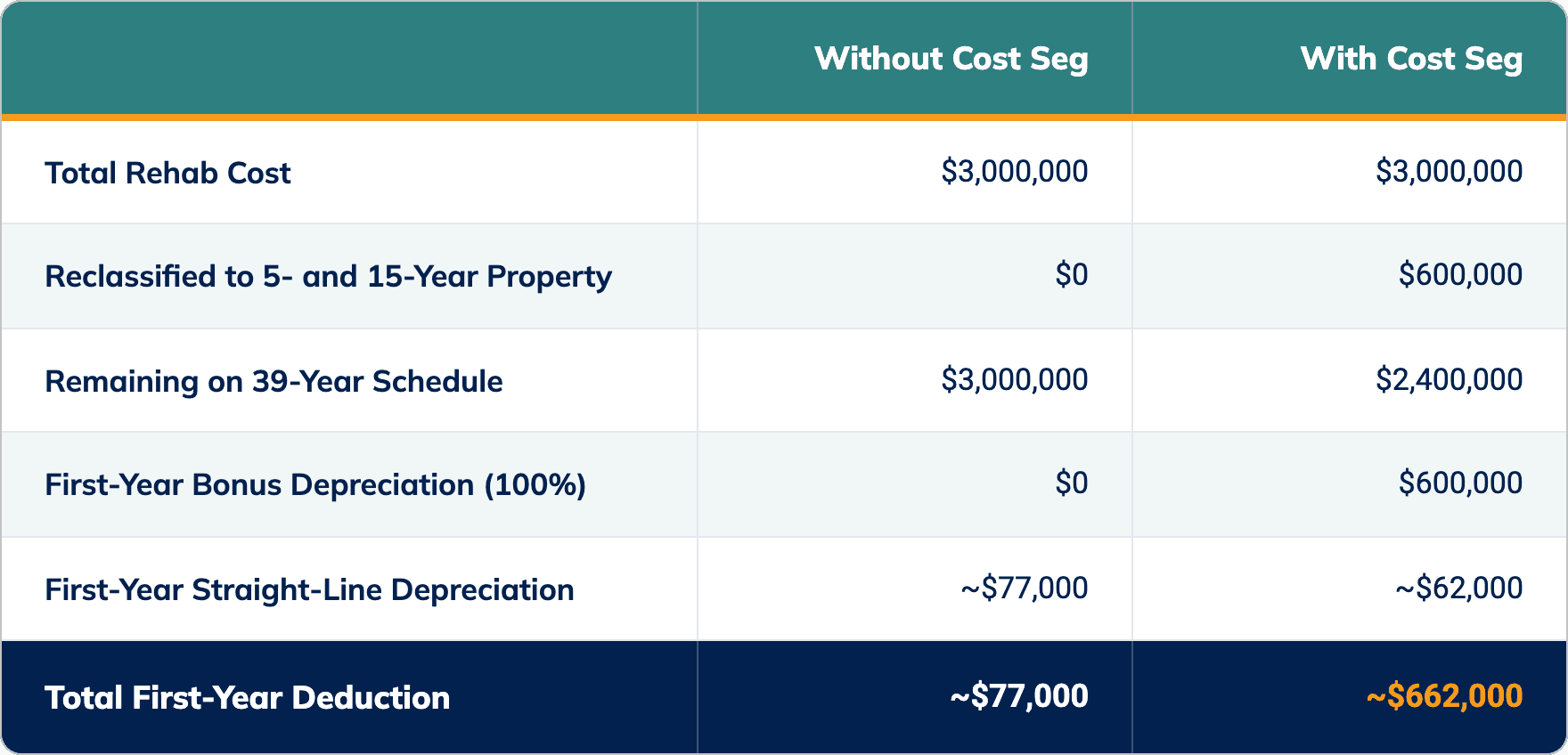
That's a difference of roughly $585,000 in first-year deductions. Actual cash tax savings depend on the owner's marginal tax rate, so this isn't $585,000 back in your pocket, but even at a mid-range rate, the acceleration is substantial enough to change how a project's first-year cash flow looks.
This example uses a 39-year schedule, which applies to nonresidential real property, the kind of building a real estate or construction rehab is more likely to involve. Most affordable housing rehabs, including nearly all LIHTC properties, are residential rental property on a 27.5-year schedule instead. The exact numbers shift accordingly, but the underlying mechanic is the same: cost segregation still pulls qualifying components out of that longer schedule and into 5- or 15-year property eligible for full bonus depreciation.
Is a Cost Segregation Study Worth the Cost on a Rehab Project?
The cost of a study is worth weighing against what it typically uncovers. On most rehab projects of meaningful size, the identified deductions are a multiple of what the study itself costs. For preservation deals specifically, this matters beyond the tax return. Better first-year deductions can improve developer fee economics and investor returns, which is particularly valuable right now given the pressure on tax credit equity pricing.
A Practical Next Step
CSH's cost segregation practice has worked across affordable housing, real estate, and industrial and manufacturing rehab projects. We typically recommend commissioning a study once construction wraps and final costs are known. That timing gives the engineering review accurate numbers to work from while still leaving time to reflect the results on that year's return. CSH can help determine whether a given scope of work justifies a study, including cost segregation studies built specifically for rehab projects, bonus depreciation planning, and tax strategy for preservation deals where the numbers need to work for both the developer and the investor.
If you have a rehab project moving toward completion this year, now is the right time to find out what a study would actually identify.