
Section 163(j) Relief: The EBITDA Restoration for Leveraged Deals


If your deals carry significant debt, a favorable change in the One Big Beautiful Bill Act (OBBBA) is worth a fresh look this fall. Section 163(j), the provision limiting how much business interest expense a company can deduct, became meaningfully more generous for tax years beginning after December 31, 2024. For affordable housing developers, real estate investors, and construction businesses carrying heavy debt loads, this can mean real dollars back on the table, and with extended returns landing throughout the season, now is a good time to confirm it is reflected in your numbers.
What Is Section 163(j)?
Section 163(j) caps the deduction for business interest expense at 30% of adjusted taxable income (ATI), plus any business interest income. Interest above that cap is not lost. It carries forward, but a disallowed deduction today still means less cash flow benefit now.
The challenge has been with the formula for calculating ATI. For several years, ATI was calculated on an EBIT basis, meaning Earnings Before Interest and Taxes, which excludes depreciation and amortization entirely. For capital-intensive businesses with large depreciation deductions, this meant a smaller ATI, a smaller 30% cap, and less deductible interest than expected.
This hit real estate and affordable housing developers especially hard, since these businesses typically carry significant debt and a large depreciable basis. Many clients responded by electing the Alternative Depreciation System (ADS), a straight-line method that runs 30 years for residential rental property and 40 years for nonresidential real property, specifically to reduce the impact of the interest limitation, even though that election came with its own trade-offs.
What Changed: The EBITDA Restoration
The One Big Beautiful Bill Act restores the more favorable EBITDA-based formula for tax years beginning after December 31, 2024. Depreciation and amortization are added back into adjusted taxable income, meaning Earnings Before Interest, Taxes, Depreciation, and Amortization becomes the basis for the 30% cap. A larger ATI means a larger deduction ceiling, and for many capital-intensive businesses, this translates directly into more deductible interest and lower taxable income.
For most calendar-year taxpayers, this formula has already applied since the 2025 tax year, which is exactly why the timing matters now. Many affordable housing and real estate deals are structured as partnerships, and the extended deadline for partnership and S corporation returns falls in mid-September, so this may already be on your desk. The deadline for C corporations and individual owners falls in mid-October. Either one is a good checkpoint to confirm the EBITDA-based formula, not the older EBIT-based one, is what is reflected in your numbers, with 2026 year-end planning right behind it.
One more change worth building into 2026 planning: starting with tax years beginning after December 31, 2025, interest electively capitalized into property no longer escapes the 163(j) limitation. This closes a workaround some construction and development deals have used, worth factoring in before the year is underway.
The Impact, Industry by Industry
The mechanics are the same across industries, but the deal-level impact varies by capital structure:
Affordable Housing: deals often carry construction loans, permanent debt, and soft debt from state housing agencies. More deductible interest lowers taxable income and improves overall deal returns.
Real Estate: bridge loans and other short-term, high-interest financing are common on active deals. The EBITDA restoration can meaningfully increase what is deductible in the current year rather than being pushed to a carryforward.
Construction: project-level financing on capital-intensive jobs benefits the same way, particularly for contractors carrying debt across multiple active projects at once.
The Math: A Before-and-After Example
Assume a deal generates $3,000,000 of EBIT, carries $2,000,000 in annual interest expense, and has $800,000 in depreciation and amortization (D&A) for the year. Here's how the deductible amount changes under each formula:
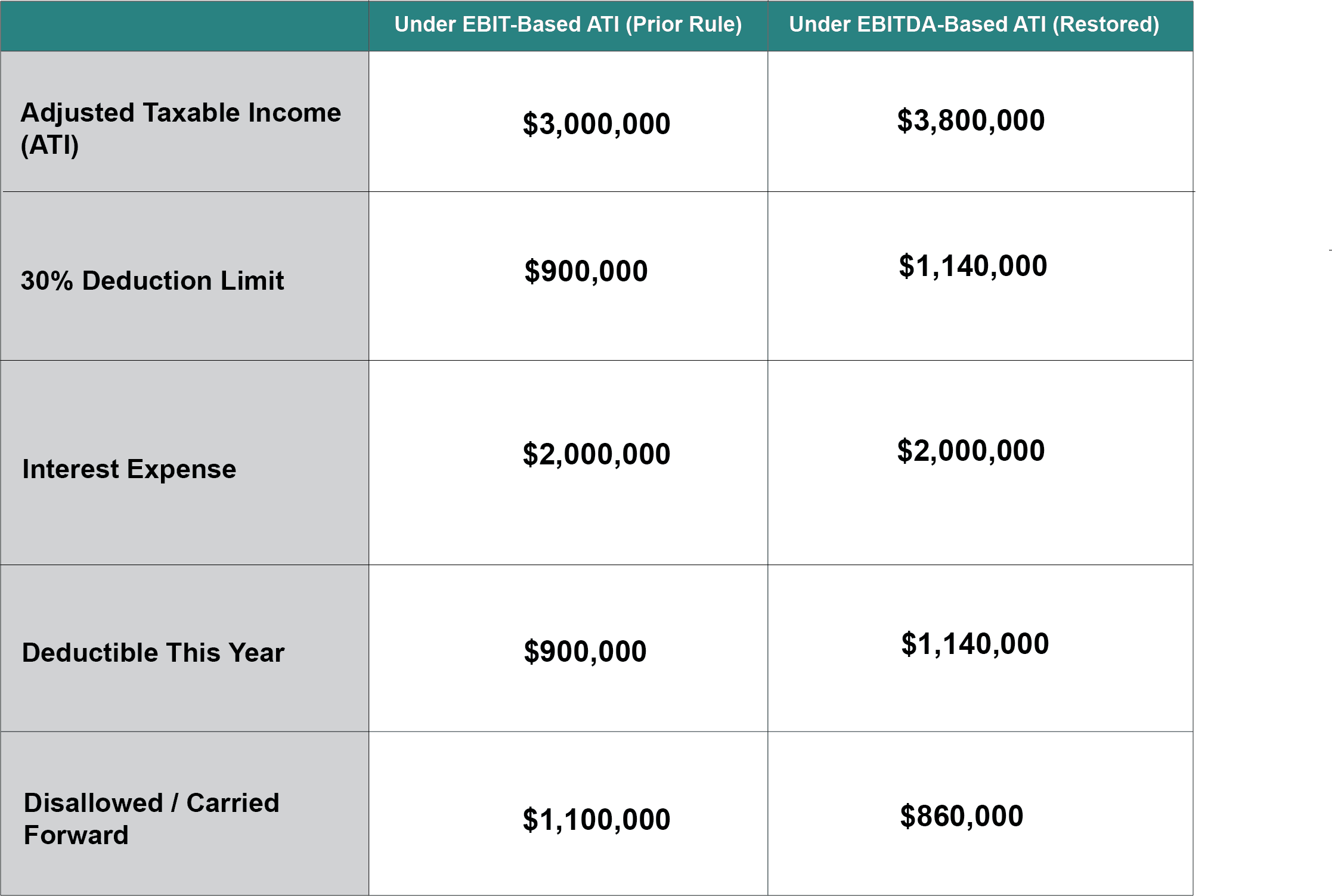
In this example, the EBITDA restoration increases the current year’s deductible interest by $240,000, with the remaining balance still available as a carryforward. Across a portfolio of several deals, that difference compounds quickly.
Bringing CSH Into the Process
A change like this is only useful once it is applied to your actual numbers, and one area worth a closer look is any prior Alternative Depreciation System (ADS) election. Clients who elected ADS to manage the old EBIT-based limitation may find the restored EBITDA formula reduces that original reason, but unwinding or keeping the election affects depreciation timing, basis, and potentially prior-year positions. CSH collaborates with clients on:
163(j) limitation modeling
Interest deductibility analysis
ADS election review
Deal-level tax planning
If your business carries significant debt across affordable housing, real estate, or construction projects, now is a good time to revisit how Section 163(j) affects your current tax position, whether your extended return already passed, is still ahead, or you're already turning to 2026 year-end planning.
Renea Irick
Senior Manager