
What Is Shadow AI in Government and How Do You Find It?
Shadow AI in government is the use of AI tools by employees without formal approval, oversight, or security review. It happens when staff paste work into a public chatbot or use an AI feature built into software they’re already using without the prior knowledge or approval of IT or leadership. Inventorying is the first step toward AI governance, which is the set of policies, roles, controls, and review practices that guide how an organization selects, uses, and oversees artificial intelligence. Before you can govern AI, you need a clear picture of which tools are in use across your organization.
Although most organizations assume they’re early in their AI journey, the technology has often arrived ahead of any decision to adopt it. Employees are experimenting on their own, and software vendors are adding AI features to products you already own. The result is a patchwork of tools that haven’t been fully vetted and that no single person or team oversees. That’s not a small problem: Thomson Reuters Institute reports (opens in a new tab) that 27% of government professionals say they use AI tools their organization hasn’t sanctioned.
Why Does Shadow AI Happen in Government?
There are several reasons for this happening, and it’s usually without bad intent. A finance director who’s behind on a deadline might type a draft budget memo into a chatbot to tighten the wording. A city clerk might turn on an AI feature that appeared in a software update. Neither one reaches out to IT because the action doesn’t feel risky. Using the tool seems harmless, so it never registers as a decision that needs approval.
That’s what makes it so difficult to manage. Public sector staff handle sensitive information every day, and a single well-meaning prompt can place resident data in a tool your organization has never evaluated. The tool might store the prompt or use it to improve its own models depending on how it’s configured. Once the information has left your environment, you may not be able to get it back.
Where Is AI Already Showing Up?
Government organizations are finding AI in more places than they expected. Common examples include:
Public chat tools such as ChatGPT used for drafting and summarizing
AI assistants built into email and productivity software like Copilot
AI features added to permitting and 311 systems
Screening and scheduling tools in HR platforms
Analytics and reporting features in police technology
Transcription and note-taking tools used in meetings
Some of these were chosen deliberately, while others arrived through an unchecked routine update or through a free trial that an employee signed up for with a work email address.
Why Is Shadow AI the First Problem to Solve?
Shadow AI comes first because it creates exposure that stays hidden from leadership. Every prompt is a potential disclosure of resident information, personnel records, or confidential communications to a third-party platform that isn’t bound by your data privacy agreements. Without an inventory, there’s no way to measure how much sensitive information has already left the environment. It also puts the organization in a difficult position when an auditor, insurer, or council member asks what AI is in use and how it’s controlled. Every other governance step depends on this one.
Visibility turns an unknown risk into a manageable one. A use that looks harmless, such as summarizing a document, becomes a serious exposure when that document contains sensitive information. When leaders can see which tools are in use and what data goes into them, they can pinpoint where the exposure sits.
How Do You Build an AI Inventory?
A useful inventory doesn’t need to be elaborate. Start with a shared spreadsheet and gather the same details for every tool. Here’s a simple template you can adapt:
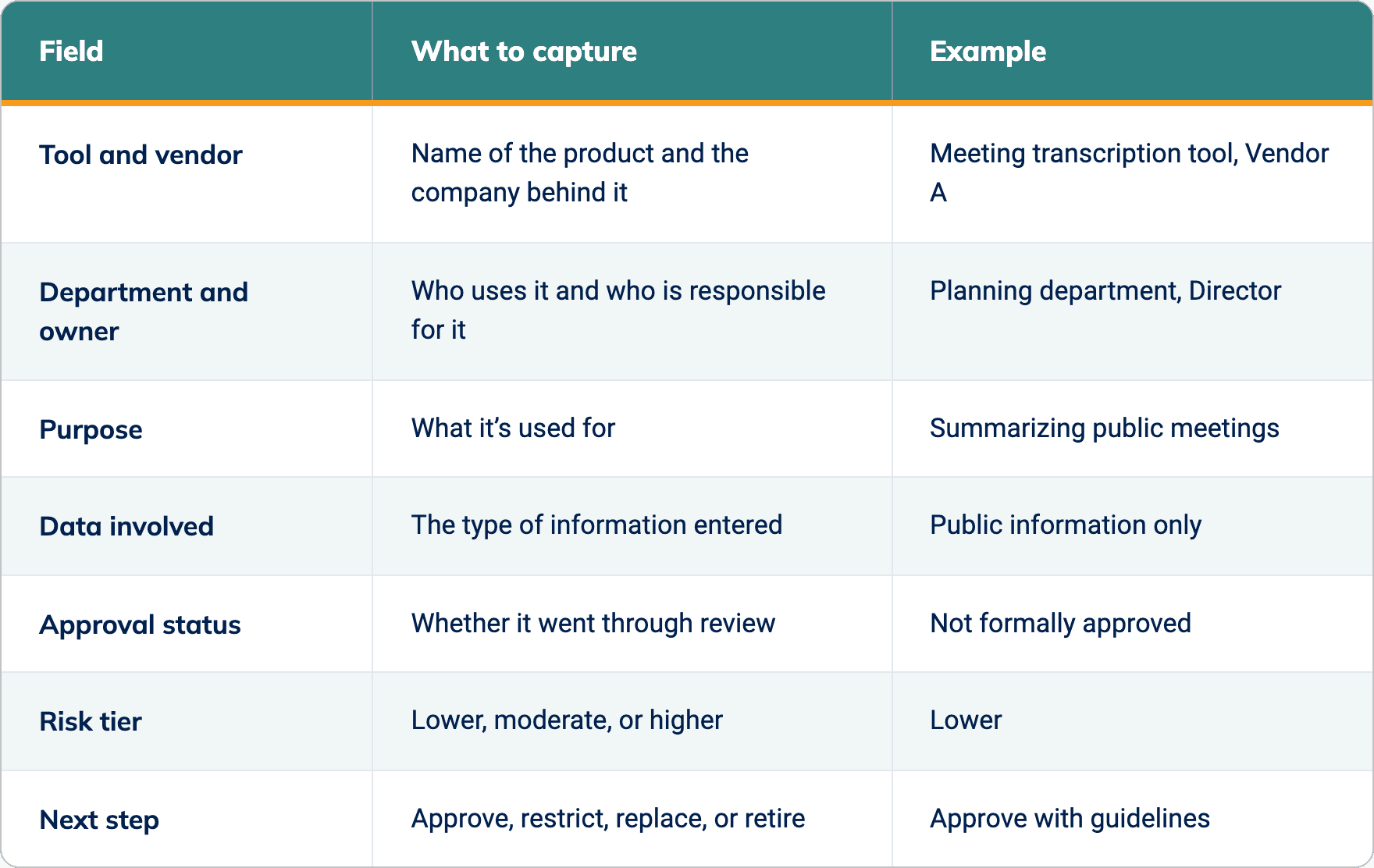
Use three sources to build the list. First, survey department heads and ask staff directly which AI tools they’re using and what they’re using them for. Approach the conversation in a way that encourages honesty, since people will share more when they believe the goal is support rather than punishment. Second, ask IT to review software contracts and network activity for known AI tools. Third, ask your vendors which of your current systems now include AI features and whether any are turned on by default.
How Should You Classify AI Use Cases by Risk?
Various uses of AI deserve different levels of scrutiny. A practical approach is to sort each use into tiers based on the potential for harm if the tool makes a mistake or mishandles information.
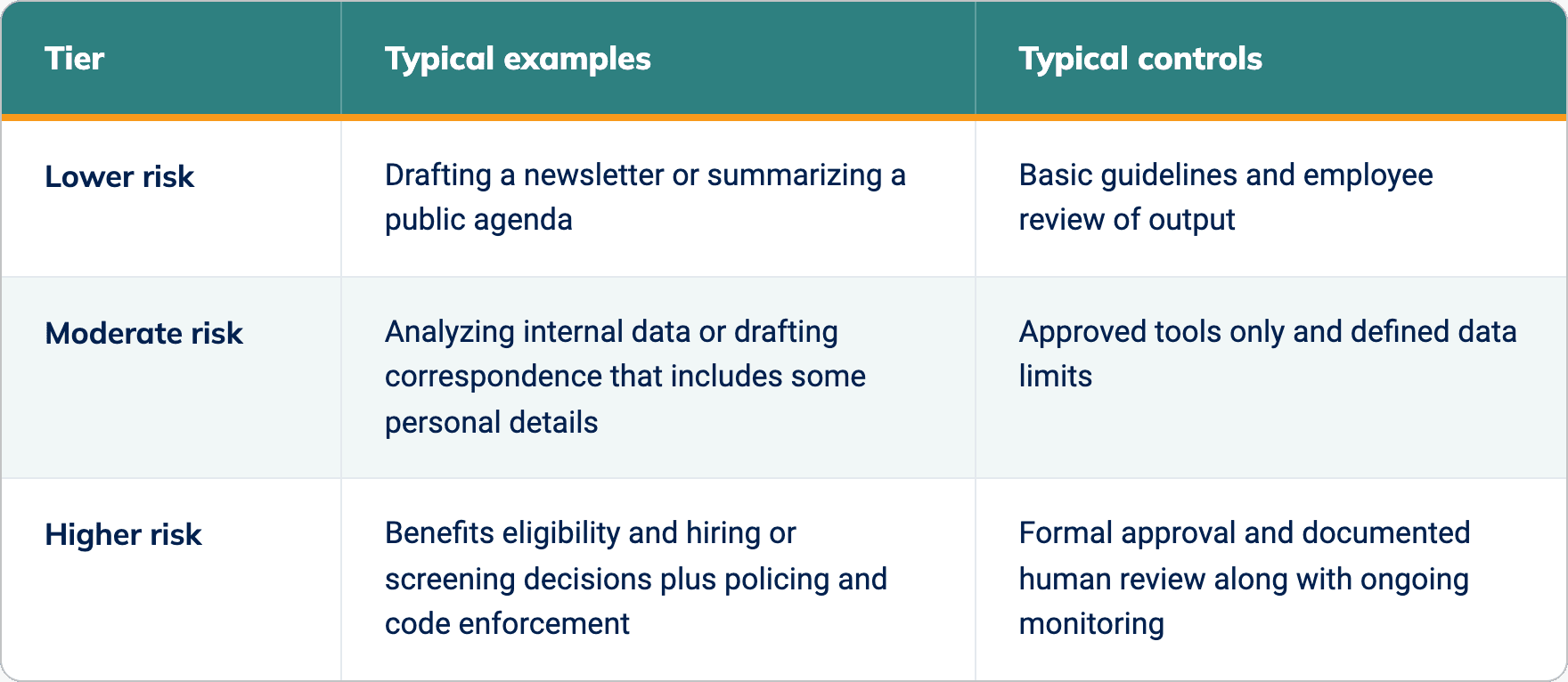
The deciding questions are simple. Does the tool touch sensitive data? Does the output affect a resident’s access to services or rights? Could an error cause serious harm that’s difficult to reverse? A yes to any of these questions moves the use toward a higher tier.
Once uses are sorted, you can focus limited time and staff on the higher tier and keep the lighter-touch rules for everything else.
Which Framework Should Guide Your AI Governance?
The NIST AI Risk Management Framework is the most common reference point, and it scales to organizations of different sizes. You don’t need to adopt every element. Its core functions of governing, mapping, measuring, and managing risk give you a recognized structure that auditors, insurers, and elected officials can all understand. Your inventory and risk tiers fit naturally into the mapping step. Since the framework is voluntary, you can adopt as much of it as makes sense for your size and resources. Some states and localities have also issued their own AI guidance or requirements, so confirm what applies to your organization.
Three AI Governance Mistakes Government Organizations Should Avoid
Government organizations tend to stumble in the same three places. The first is banning AI outright, which usually pushes use out of sight and makes it harder to manage. The second is writing a detailed policy before learning the AI tools in use, which produces rules that don’t match how the work gets done. The third is treating governance as a one-time project rather than an ongoing responsibility. Starting small and staying consistent works better than aiming for a perfect first pass.
Many organizations recognize that AI is already in use but lack the resources or structure to govern it with confidence. Creating a defensible approach requires an accurate inventory of the tools in use, plain-language policies with defined oversight, and consistent, audit-ready documentation.
CSH works with government organizations to establish clear policies, strengthen oversight, and embed accountability into how AI is used day to day. The focus is on building practical, sustainable frameworks that address data privacy, model risk, and regulatory compliance while improving auditability and trust in the results.
Frequently Asked Questions
What is AI governance?
It’s the framework of policies, roles, and oversight that determines how an organization selects, uses, and monitors AI tools.
Why does government need AI governance now?
Staff are already using AI tools, often without approval. Governance gives leaders visibility and control before a problem occurs.
What is shadow AI in government?
It’s the use of AI tools by staff without formal approval or review. It’s common in government because AI is easy to access and built into so much software.
What is an AI inventory?
It’s a list of every AI tool and AI-enabled feature in use along with its owner, its purpose, and the data it touches.
Does every government organization need AI governance?
Yes. The approach can scale to fit the size of the organization, but any organization that handles resident data benefits from knowing what tools are in use.

Carly Devlin
Shareholder, Chief Information Security Officer